Neighbourhood guide
High Desert
High Desert is the most deliberately controlled of Albuquerque's upper-tier neighbourhoods. It was master-planned against the foothills on the far northeast side, and almost everything that makes it feel the way it does — the gaps between houses, the dark sky at night, the arroyos that were left alone — is the result of covenants that are still enforced. Buying here means buying into that document as much as into the house.
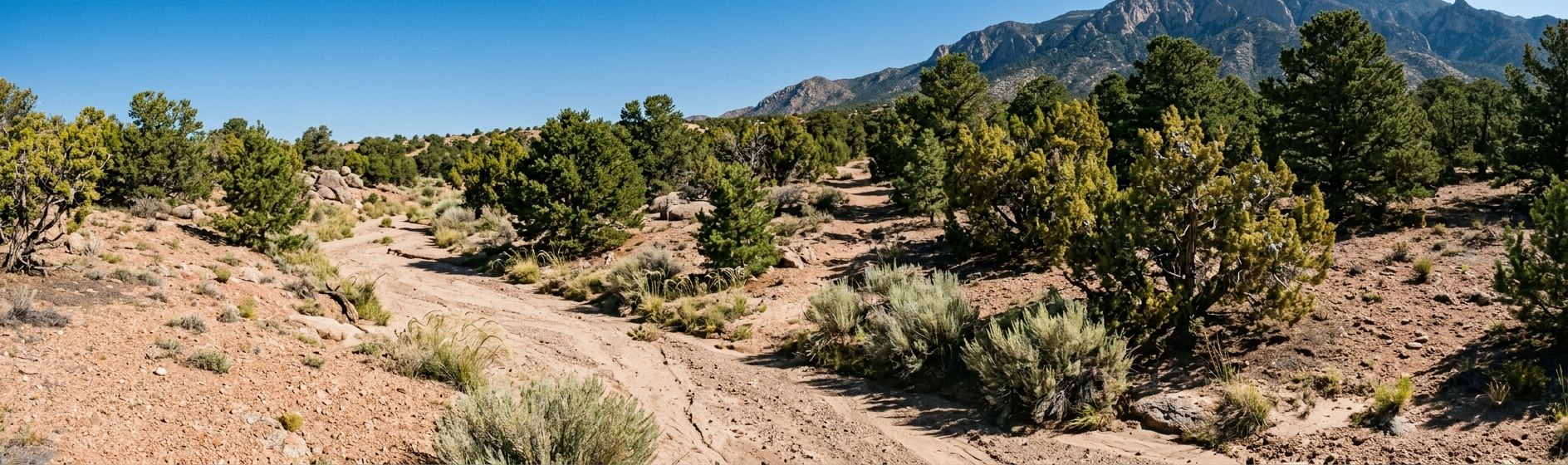
Building envelopes are the defining feature
Lots in High Desert are large, but the buildable portion of a lot is usually smaller than the lot. Development was laid out so that arroyos, drainage corridors and open space were left between properties, and each lot carries an envelope describing where structure may go. Two lots of the same recorded size can therefore support very different houses. If you are buying with any intention of adding a casita, a shop, a pool house or a larger garage, the envelope — not the acreage — is the number that governs, and it is worth reading before the offer rather than after.
Lighting, landscaping, and what the covenants reach
The neighbourhood's dark-sky lighting standard is the reason the foothills still look the way they do from the valley floor, and it applies to fixtures, shielding and placement. Landscaping standards push toward native and xeric planting rather than lawn. Exterior colour, roof material, wall height and even the visibility of mechanical equipment are typically governed as well. None of this is unusual for a planned community, but the review process is real, and a buyer who plans to change the exterior should treat approval as a step with a timeline rather than a formality.
Open space, trails, and the lots that back onto it
Part of the reason the same street can carry very different values is what is behind the house. Lots that back onto retained open space or onto the Sandia foothills trail system are finite, and they do not come back on the market often. Lots that back onto another envelope are a different proposition. When you tour, it is worth walking the rear boundary rather than looking at the plat, because the plat will not tell you what the sightline is actually like at eye level.
What diligence tends to turn up here
Most High Desert housing stock is late-1990s onward, so the questions are rarely about age. They are about drainage across a sloped lot, about stucco and parapet condition after two decades of high-desert sun and monsoon, about whether earlier owners' exterior changes were ever approved, and about the HOA's reserve position. Ask for the covenants, the current rules and regulations, the architectural guidelines and the most recent financials together — reading them as a set is how the pattern shows up.
Common questions
Is High Desert a gated community?
High Desert is not gated as a whole. It is a covenant-controlled master-planned community with an active association, and some individual enclaves within it have their own arrangements. If a gate is a requirement for you, confirm it at the specific street rather than assuming it from the neighbourhood name.
Can I build a casita or a detached garage in High Desert?
It depends on your lot's building envelope and on architectural review, not on the size of the lot. Ask for the envelope and the current architectural guidelines before you write an offer if this matters to your plans.
Why do the lighting rules come up so often?
High Desert's dark-sky standard governs exterior fixtures, shielding and placement, and it is one of the more actively enforced covenants. Buyers who intend to add landscape or security lighting should plan on approval as a real step.
Start a search
Tell Phillip what you are looking for
A short note is enough to start. You will hear back from Phillip Archuleta directly — not from a call centre, and not from a lead service.